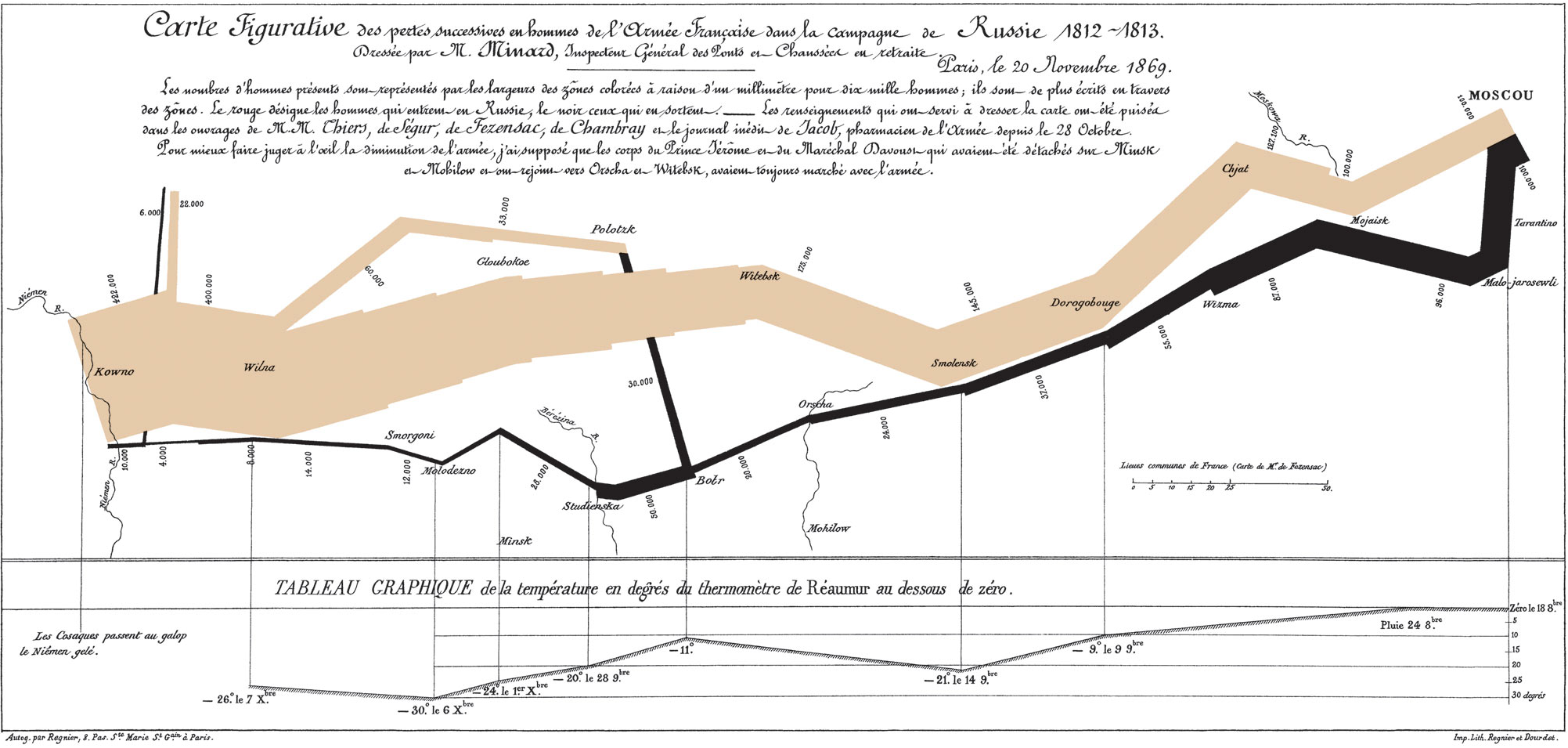
Well, maybe not the final post, but close to it. With the end of the 200th anniversary of the Russian campaign, I will no longer be making regular posts. Starting in May of 2011, I’ve been attempting to bring the stories of the participants in this disastrous campaign to life. This is post number 238 during that period. In 2012, the bicentennial of the campaign, there have been posts on 117 days of the 175 day campaign (67%)(some of the posts are enhanced re-posts from 2011 – the 199th anniversary).
Wherever possible, I matched the date of the eyewitness account to its 200th anniversary to give the reader as much of a connection with the participants as possible. The goal was to make the reader feel a part of the event. As a result, I’ve mostly ignored the strategy and concentrated on the human aspect. My favorite post was about a lost glove. Something so simple could have tragic consequences.
This blog is the result of research I did to write a work of historical fiction for middle school readers. While the hero of my book, Henri Carle, is only 14, many adults have read the story and found it entertaining. If reading this blog has put you in the mood for a good Russian campaign adventure story, order yourself a copy of Russian Snows: Coming of Age in Napoleon’s Army and enjoy it some night this winter in front of a warm fire. You’ll probably recognize a few of the scenes in the book as they were inspired by eyewitness accounts.
—
Another interesting thing that came out of the writing of Russian Snows, was that a fellow re-enactor pointed out that a veteran of Napoleon’s Russian campaign is buried at a local church, only a few miles from where I live in southeastern Pennsylvania, USA. While I have made no attempt to verify the validity of the veteran’s claim, here is the little bit of the story that we know according to a pastor who was giving his recollections many years later.
“Among the interesting reminiscences is the life and character of Father Knapp. He was quite up in years when I became pastor in 1865. He died about thirty years ago, aged eighty-four. In character he was sturdy and pronounced. Outspoken candor marked all his doings. Between opinions he never halted. He was in Napoleon’s Russian campaign. Often he was near that august personality; had brought him dispatches; taken orders from him to others, thus had business acquaintance and conversation with him. To hear him talk seemed like a dream. It seemed so strange to speak with a man who had personally spoken with Napoleon. About the horrible campaign he could talk by the hour. Incident and general movements he remembered well and stated them vividly. I delighted to listen to him. His frequent nearness to the great emperor gave him opportunities of knowing things. His statements came with authority.”
Thank you to Lee Wessner for providing the text and photo about John Knapp.
—
Thank you to everyone who has read this blog. I hope it serves as a reference for years to come.
In Antony Brett-James book, 1812 Napoleon’s Defeat in Russia, is the account by Count Mathieu Dumas, the Intendant-General of December 14, 1812, the day the last Frenchman left Russia. “At long last we were out of that cursed country – Russia. The Cossacks no longer pursued us with such zeal. As we advanced across Prussian territory we found better lodgings and resources. The first place we could draw breath was Wilkowiski, and then Gumbinnen, where I stopped at a doctor’s house as I had done when I first passed through the town. We had just been served with some excellent coffee when I saw a man wearing a brown coat come in. He had a long beard. His face was black and seemed to be burnt. His eyes were red and glistening. ‘Here I am at last!’ he said. ‘What, General Dumas! Don’t your recognize me?'”
“‘No. who are you?'”
Marshal Ney with the Rearguard
“‘I am the rearguard of the Grand Army, Marshal Ney. I fired the last shot on the bridge at Kovno. I threw the last of our weapons into the Niemen, and I have come as far as this through the woods.'”
“I leave to your imagination with what respectful eagerness we welcomed the hero of the retreat from Russia.”
—
Despite the heroics of Marshal Ney, many men suffered a different fate. James Fisher provides the following account from the Russian point of view.
(14th December) Final, Hellish Retreat
Rafail Zotov, was just out of school when the war began and volunteered to join the St Petersburg opolchenye, part of Wittgenstein’s Corps.
The Retreat from Russia Firing at Cossacks
“On 2 December [14 December]* we caught up with Chichagov’s men and let them ahead of us so they could claim all the laurels of the pursuit. This movement marked the start of the most severe frost, which even those of us who lived in St Petersburg had rarely experienced. Temperatures dropped every day and reached -23º to -25º Réaumur [-29º to -31º Celsius]. This was a final devastating blow to the French army, which completely lost its morale. Its every bivouac and encampment was like the terrifying sight of the battlefield, where thousands lay dying in great agony. And so the warriors who perhaps survived Austerlitz, Eylau and Borodino now easily fell into our hands. They were in a state of trance so that every Cossack captured and brought back dozens of them. They could not comprehend what was happening around them, could not remember or understand anything. The roads were littered with their corpses and they lay abandoned and without any attention inside every hut.”
*Dates according to Julian [and Gregorian] calendar
Mikaberidze, A (2012) Russian Eyewitness Accounts of the Campaign of 1812. Frontline Books (an imprint of Pen & Sword Books Ltd), Barnsley, South Yorkshire, UK. p. 246.
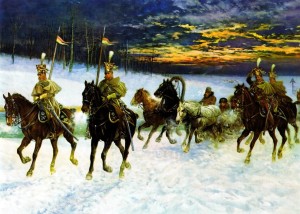
Partizans in Ambush Commemorative 1912 Russian Candy Box Card
Sergeant Adrien Bourgogne‘s memoirs tell of his narrow escape from some Cossacks around this time [Approximately December 13, his narrative doesn’t use many dates](He was alone in the woods and three Cossacks were closing in on him when nearby gunfire frightened their tethered horses and they had to rush off to retrieve them). Now alone in the woods, “… I felt it would be impossible to walk further without changing my clothes. It may be remembered that in a portmanteau found on the mountain of Ponari I had some shirts and white cotton breeches – clothes belonging to an army commissary. Having opened my knapsack, I drew out a shirt, and hung it on my musket; then the breeches, which I placed beside me on the tree. I took off my jacket, an overcoat, and my waistcoat with the quilted yellow silk sleeves that I had made out of a Russian lady’s skirt at Moscow. I untied the shawl which was wrapped round my body, and my trousers fell about my heels. As for my shirt, I had not the trouble of taking it off, for it had neither back nor front; I pulled it off in shreds. And there I was, naked, except for a pair of wretched boots, in the midst of a wild forest at four o’clock in the afternoon, with eighteen to twenty degrees of cold, for the north wind had begun to blow hard again.”
“On looking at my emaciated body, dirty, and consumed with vermin, I could not restrain my tears. At last, summoning the little strength that remained, I set about my toilet. With snow and the rags of my old shirt I washed myself to the best of my power. Then I drew on my new shirt of fine longcloth, embroidered down the front. I got into the little calico breeches as quickly as I could, but I found them so short that even my knees were not covered, and my boots only reaching half-way up my leg, all this part was bare. Finally, I put on my yellow silk waistcoat, my riding-jacket, my overcoat, over this my belts and collar; and there I was, completely attired, except for my legs.”
–
On the 13th of December, 1812, the Grande Armée reached Kovno at the edge of the Russian empire. Philippe-Paul de Ségur described the scene: “After a final crucifying march of forty-six hours, they found themselves again on friendly soil. Immediately, without pausing, without casting a glance behind them, the majority of the men dispersed and plunged into the forests of Polish Russia. But some did turn around when they reached the other side of the river, and look back on the land of suffering from which they were escaping. It is said that when they found themselves on the very spot from which, five months before, their innumerable eagles had victoriously set out, tears ran down their cheeks and groans broke from their chests.”
“Here were the same valleys down which had poured those three long columns… [Now] The Niemen was just a long mass of blocks of ice piled up and welded together by a breath of winter. In place of the three French bridges brought fifteen hundred miles and erected with such daring speed, there was only one Russian bridge. Instead of the four hundred thousand companions… [the only ones left were] one thousand foot soldiers and troopers still armed, nine cannon, and twenty thousand beings clothed in rags, with bowed heads, dull eyes, ashy, cadaverous faces, and long ice-stiffened beards. Some of them were fighting in silence for the right to cross the bridge which, despite their reduced number, was still too narrow to accommodate their precipitous flight. Others had rushed down the bank and were struggling across the river, crawling from one jagged cake of ice to another. And this was the Grand Army!”
Marshal Ney in Action
“Two kings, one prince, eight marshals, followed by several generals afoot and unattended, then a few hundred of the Old Guard still bearing arms, were all that remained of the original host. It might be said, though, that it lived on incarnate in the person of Marshal Ney. Friends, allies, enemies – I call on you to witness! Let us render the homage that is due to the memory of this unfortunate hero … In Kovno he found a company of artillery, three hundred Germans belonging to
Jean Gabriel Marchand
the garrison, and General [Jean Gabriel] Marchand with four hundred armed men, of whom he took command. His first act was to scour the city looking for possible reinforcements. All he found were the wounded who were making a pitiful attempt to keep up with our wild flight. For the eighth time since leaving Moscow he had to abandon them in a body in the hospitals, as he had abandoned them individually along the road, on the battlefields, and around all the campfires.”
“Several thousand French soldiers were crowded together in the great square… but these were stretched out cold and stiff in front of the brandy shops which they had broken open, and in which they had imbibed death, instead of the life they had hoped to find. Here was the only relief that Murat had left him! So Ney found himself alone in Russia at the head of seven hundred foreign recruits. At Kovno, as at Vilna, the honor of our arms and the dangers of the last retreat were committed to his care, and he accepted them.”
As the 200th anniversary of the campaign comes to a close, we have one last guest post by Alice Shepperson. Alice has summed up the career of Marshal Murat, paying particular attention to the attributes that made him a good (or not so good) choice to take over command of the destroyed Grande Armée when Napoleon left it to return to France in December of 1812.
—
On leaving the Grande Armée in December 1812, Napoleon appointed his brother-in-law, Joachim Murat as commander-in-chief. The King of Naples would desert just six weeks later, leaving Prince Eugène to attempt to rescue the army’s desperate situation. How was Napoleon so mistaken?
Joachim Murat
Joachim Murat was the son of a country innkeeper. His family intended him for the church and sent him to study theology in Toulouse. Given his flamboyant, energetic nature, extreme vanity and powerful, athletic build, Joachim’s relations should not have been surprised when at the age of twenty he ran off with a passing cavalry regiment. Joachim enlisted as a private, but with the coming of the Revolution, officer rank came within the grasp of commoners – especially well educated, loudly republican commoners like Murat.
Lieutenant Murat came to Napoleon’s attention on 13 of Vendemiaire 1795. He happened to be in temporary command of the 21st Chasseurs when Bonaparte ordered them to seize the 40 guns of the National Guard on the Place de Sablons. Thus it was Murat who provided Napoleon with the “whiff of grapeshot”, that saved the Convention and made him a national hero. Murat was rewarded with an appointment as Napoleon’s aide-de-camp.
Murat at Aboukir
In Italy, Egypt and soon throughout Europe, Murat proved himself a fearless and effective cavalry commander, renowned for his reckless bravery and desire to lead every charge in person. His tactics involved quick movement and rapid strikes, exploiting any mistakes by the enemy. At the battle of Aboukir, his attack was so swift that he overtook the Turkish commander, who in resisting capture, shot Murat through the jaw. Refusing to go to hospital, he bandaged up his face and carried on with the battle.
Caroline Murat and Family
Murat’s relationship with Napoleon was complex. He was instrumental in Napoleon’s rise to power, securing the cavalry’s support for his coup of Brumaire 1799. Soon after, Murat secured Napoleon’s consent to marry his favourite sister, Caroline. Now part of the family, Murat took an active part in the squabbling, intrigues and backstabbing habitual to the Bonapartes, mostly aimed at ensuring each sibling got their fair share of the palaces, titles and territories dispensed by Napoleon. Josephine complained to Madame de Remusat that the Murats “…kept up their own influence by exciting the Consul to passing fancies and promoting his secret intrigues.” Though, Napoleon often found his family excessively grasping, Murat remained indispensible as both a commander and an ally.
However, when Napoleon gave Murat the crown of Naples in 1808, their relationship began to sour. Murat was a proud man and felt that like any monarch he should have free rein in his own kingdom, while Napoleon treated him as a mere French military governor, constantly questioning his domestic policy, dictating the movements of French troops in Naples and generally interfering. This caused constant chaffing between the two men.
Murat’s Best Uniform
Being crowned also inflated the dandy in Murat. His personally designed battle costume for the Russian campaign consisted of long yellow leather boots, crimson and gold fur-lined breeches, blue tunic with gold lace, red velvet pelisse and a tricorn hat decorated with ostrich feathers and diamonds. This was set off by a diamond encrusted sabre and gold spurs. A less conspicuously brave man would have been ridiculed.
By 1812, Murat and Napoleon appeared to have buried their differences and the “First Horseman of Europe” once again served with distinction, taking a leading role at Borodino and almost every other engagement. As commander of the cavalry, his responsibilities were especially onerous. On the advance, the cavalry were employed in chasing the Russian rearguard, and throughout the campaign Cossack raids made constant patrols necessary, which Napoleon insisted should be large enough to prevent detachments being isolated and killed. In addition, the cavalry were expected to forage for the rest of the army and do reconnaissance. There was simply no time to feed and rest tired mounts. By the crossing of the Beresina there were only 1,800 mounted cavalrymen left.
On the 5th of December, Napoleon left the Grande Armée in the care of Murat. For several reasons, he was the natural choice: he was a king and therefore highest ranking; he was family, implying loyalty to the Empire; he was an experienced commander-in-chief who had held independent commands since 1801.
For several other reasons, Murat was a terrible choice:
Murat’s elevation to kingship, rather than binding him more tightly to the Emperor, had in fact made him less reliable. Obsessed with maintaining his new dignity, his chief concerns were now not with the army, but in Naples with Caroline, their children and his crown. When Devout reminded him that he owed his kingdom to Napoleon and to French blood, he replied, “I am as much King of Naples as Francis is Emperor of Austria and I may do as I please.”
Napoleon and Murat in Russia
Murat was also intrinsically ill-suited to the enormous task. As Berthier wrote, “The King of Naples is the first of men for executing the orders given by a commander-in-chief on the battlefield. The King of Naples is in every way the most incapable of acting as commander-in-chief himself.” Almost as soon as he took command, Murat asked to hand it over to Eugène, who he said was more experienced in administration. This was not strictly true, as Murat had been organising whole armies for longer, and administering his own kingdom since 1808. Napoleon put it well when he later said to Caroline, “He is a brave man on the battlefield, but feebler than a woman or a monk when the enemy is not in sight. He has no moral courage.” Murat was perfectly capable of detailed administration when the goal was victory. Without the prospect of new glories to spur him on however, he lost motivation, and lacked the inner resources to find it again.
The Russian campaign had also affected Murat deeply. He was physically and mentally exhausted, and though a veteran of many battles, was at least sick at heart, if not actually shaken. Berthier wrote in a dispatch to the Emperor in December, “The King of Naples is very unsettled in his ideas”, and recommended again that he be replaced.
By January 15th, Murat was pleading that he must leave the army on the grounds of ill-health, though when he did leave on the 17th, he managed to travel straight to Naples without stopping. “Not bad for a sick man!” was Eugène’s assessment.
Marshal Murat
Most importantly though, Murat had lost faith in Napoleon. After Leipzig, he abandoned the French cause to save his kingdom, only to take it up again during the Hundred Days when the allied powers looked to dethrone him. Following Waterloo he fled to Corsica, from where he tried to organise an insurrection to regain Naples. Neapolitan forces eventually captured him and he was executed by firing squad. Vane and defiant to the last, he faced his death standing and without a blindfold, shouting, “Soldiers! Do your duty! Straight to the heart but spare the face. Fire!”
When Napoleon left the army to return to Paris, he left Marshal Murat, King of Naples, in charge. Captain Coignet of the Imperial Guard Grenadiers writes in his memoirs, “But it was a Wilna that we suffered most. The weather was so severe that the men could no longer endure it; even the ravens froze.”
The Retreat by Nicolas Charlet Note the birds overhead
“We remained under the command of the King of Naples, and were not too happy in our minds, for, though he was always the first to draw a sabre or brave danger, he may truly be said to have been the executioner of our cavalry. He kept his divisions constantly mounted all along the route, and they were more than enough to keep the Cossacks at bay; but our cavalry were dying of starvation, and when night came, the unfortunate soldiers were not able to use their horses to go for forage… He was, indeed the handsomest horseman in Europe; but without foresight, for it was not a question of being an intrepid soldier, but of being able to economize his resources. He lost us (I heard this said to Marshal Davout) forty thousand horses through his mismanagement. It is always wrong to blame one’s officers; but the Emperor could have made a better selection. There were among our leaders two warriors, rivals in glory, Marshal Ney and Prince Beauharnais, who saved us from the greatest perils by their coolness and courage.”
“The King of Naples went on to Wilna; he arrived there on the 8th of December, and we with the guard, on the 10th. It was night when we came to the gates of the city, which were barricaded with pieces of wood. We had the greatest difficulty in entering. I and my comrade were lodged in a school, well warmed.”
“When I went to my general of orders, he said, ‘Be ready at four in the morning to leave the city, for the enemy is now arriving on the heights, and we shall be bombarded at daylight. Do not lose any time.'”
“We had scarcely got ready to leave when the Russians forced the Witepsk gate; we had barely time to get out… When we reached the mountain of Wilna the confusion was at its height. All the material of the army and the Emperor’s carriages were on the ground. The soldiers helped themselves to gold and silver plate. All the chests and casks were burst open. What a quantity of plunder was left on that spot! No, a thousand times no; never was there such a sight!”
—
Louis Victor Léon Rochechouart, the French emigré officer serving on [Pavel] Chichagov’s [Russian] staff, describes the scene upon entering Vilna:
“On 11 December, when the cold reached -29º Réaumur [-36º Celsius], I entered Vilna, crouching at the bottom of the carriage. We traveled forward amid human remains, frozen on the road, and hundreds of horses that had died of hunger and cold, or had broken their legs, for they were not roughshod; our servants walked in front thrusting the obstacles in the way to the right or left. It is impossible to imagine the state of Vilna during the four days after our arrival; we found sick or wounded prisoners—Frenchmen, Poles, Germans, Spaniards, Italians and Portuguese, crowded into the various convents and monasteries. It was necessary to house everybody. Happily, the French government had accumulated immense stores of provisions, which they had not been able to use, being so closely pursued by the Russians. They were distributed among all. The frozen snow which covered the streets deadened the sound of the vehicles that were constantly passing, but did not prevent hearing the cries of the wounded asking for food, or the drivers urging their horses on.“
Faber du Faur’s depiction of the 11th of December has the following description:
Near Eve, 11 December by Faber du Faur Note the hands in the lower left
Near Eve, 11 December
“We left Vilna on the 10th and abandoned thousands of dead, dying and prisoners. We managed to avoid the chaos at Ponari, which cost the army most of the rest of its artillery and transport – and even the Imperial Treasury – and made our weary way towards Kovno, protected by a weak rearguard but sill suffering from the relentless cold. A vast number of men died on this final forced march.”
“We finally reached Eve, a small town familiar to us from having passed through it that very summer. How things had changed! Eve was stripped of the charms of summer, abandoned and partially buried under the deep snow. And the town, which in the summer had seen a brilliant army march through, was now obliged to see its ghostly streets play host to groups of miserable individuals, ruined by the Russian climate and by hunger and hoping for nothing more than to reach the banks of the Niemen at Kovno.”
Philippe-Paul de Ségur described the abandonment of Vilna on the 10th of December. He contended that Vilna cost the army twenty thousand men and many of these could have been saved had the city been held twenty-four hours longer. But Marshal Murat panicked when the Cossacks appeared and the city was hastily abandoned.
Here is Ségur’s description of the events: “On the tenth of December, Ney, who had voluntarily taken command of the rear guard, left the city, and immediately Platov’s Cossacks overran it, massacring the unfortunate wretches whom [were thrown]… into the streets as they passed by…”
“This city contained a great part of the equipment and the treasury of the army, its supplies, a number of immense covered wagons with the Emperor’s possessions, much artillery, and a great many wounded men. Our sudden appearance had fallen like a thunderbolt on those in charge of all this. Some were galvanized into action by terror, others were paralyzed by consternation. Out of it came orders and counterorders of all sorts, and men, horses, and vehicles became tangled in an inextricable jam.”
“In the midst of this chaos several officers succeeded in getting as much as could be set in motion, out if town and on the road to Kovno. But when this bewildered, heavily loaded column had gone about two miles they were stopped by the hill and narrow pass of Ponari.”
“In our conquering march eastward this wooded knoll had seemed to our hussars little more than a slight irregularity in the earth’s surface from the top of which the entire plain of Vilna could be seen, and the strength of the enemy estimated. In truth, its steep but short slope had hardly been noticed. In a regular retreat it would have been an excellent position for turning around and checking the enemy; but in a chaotic flight, where everything that could be of use became a hindrance, when in blind haste we turned everything against ourselves, this hill and defile were an unsurmountable obstacle, a wall of ice against which our best efforts were broken. It stripped us of everything – supplies, treasury, booty, and wounded men. This misfortune was serious enough to stand out above all our long succession of disasters; for it was here that the little money, honor, discipline, and strength remaining to us were irrevocably lost.”
“When, after fifteen hours of fruitless struggle, the drivers and soldiers forming the escort [of the wagons carrying the booty] saw Murat and the column of fugitives go past them on the hillside… they no longer thought of saving anything, but only of forestalling the avidity of the foe by pillaging themselves.”
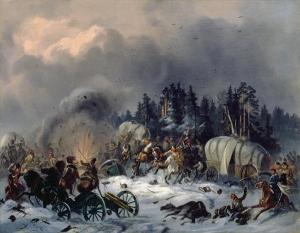
Retreat Scene from the Russian-French War of 1812 by Bogdan Willewalde
“The bursting of a wagon carrying loot from Moscow acted as a signal. Everybody fell upon the other wagons, broke them open, and seized the most valuable objects. The soldiers of the rear guard coming upon this confusion, threw down their arms and loaded themselves with plunder. So furiously intent were they on this that they failed to heed the whistling bullets or the shrieks of the Cossacks who were pursuing them. It is said that the Cossacks mingled with them without being noticed. For a few minutes Europeans and Tartars, friends and foes, were united in a common lust for gain. Frenchmen and Russians were seen side by side, all war forgotten, plundering the same wagon. Ten million francs in gold and silver rapidly disappeared!”
“But along with these horrors, acts of noble devotion were noticed. There were men that day who forsook everything to carry off the wounded on their backs; others, unable to get their half-frozen companions out of the struggle, perished in defending them from the brutality of their fellow soldiers and the blows of the enemy.”
“On the most exposed spot of the hill a colonel of the Emperor’s staff, Count de Turenne, held the Cossacks at bay, disregarding their wild shots, while he distributed Napoleon’s personal treasury among the guards who stood within sight and hearing. These brave men, fighting with one hand and holding the riches of their leader in the other, succeeded in saving all of it. Long afterward, when we were out of danger, each one returned the amount that had been entrusted to him: not a single gold coin was lost.”
“The catastrophe at Ponari was all the more shameful as it could have been easily foreseen, and even more easily avoided; for it was possible to pass around the hill on either side. Our debris served at least one purpose – to stop the Cossacks.”
Faber du Faur continues with his narrative of the arrival of the army at Vilna: “On the 9th the bulk of the army, some 40,000 desperate men, arrived before Vilna in a state of the most abject confusion. Pursued by Russian columns, they threw themselves into the town, although thousands were crushed to death at the gates. Just as at the Beresina, a crowd of deranged, desperate individuals, trampling the dying underfoot, stormed forward in an attempt to get into the safety of the town’s streets. The frightened inhabitants bolted their doors and refused entry to anyone. It was a heart-rending sight to see the crowd of unfortunates covered in rags, supplicating in the streets as the temperature dropped to 28 degrees. In vain did they seek shelter; even the magazines were closed to them as written permission was required to enter therein. Nor was there any room in the hospitals and barracks: these had long been filled to the brim, their long corridors and fire-less rooms choked with the dead and dying and presenting a picture of utter horror.”
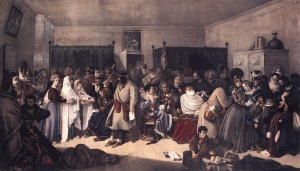
French Army in the Town Hall Square of Vilnius, Lithuania
“The Jews behaved badly towards us. Whilst the Allied army had still been present in force, they came and offered their services and goods and even invited individuals into their houses. However, as soon as news of the Russian approach was received they threw Allied troops out into the cold streets, thereby seeking to ingratiate themselves in the eyes of the victors.”
“Amidst all the scenes of horror and destruction, the rumble of cannon was a timely reminder that we had to quit the town at once. The Russians were attacking our rearguard, and no sooner had we left from one side of the town, on the 10th, than the Cossacks entered the other. The Grande Armée resumed its march, heading towards Kovno.”
December 8 and 9, 1812 were the coldest of the retreat. Accounts of this time detail the misery of those who had struggled on so far as the cold reached new depths. The goal was to reach Vilna with its supposed stocked warehouses and shelter from the cold. But the men were wary, having experienced the disappointment of Smolensk when the stores and shelter there were inadequate.
Lieutenant Albrecht von Muraldt wrote about how his companions were reacting: “Some wept and whimpered. Others, totally stupefied, didn’t utter a sound. Many behaved like lunatics, especially at the sign of a rousing fire or when, after starving for several days, they got something to eat. Only very few indeed were still themselves.”
Surgeon-General Dominique Jean Larrey wrote about the effects of the cold on the starving men: “The muscular action became noticeably weaker. Individuals staggered like drunken men. Their weakness grew progressively until the subject fell – a sure sign that life was totally extinct.” Men who couldn’t keep up had to get to the side of the road, where, lacking the support of their comrades, would fall. “Instantly they were stricken by a painful stupor, from which they went into a state of lethargic stupor, and in a few moments they’d ended their painful existence. Often, before death, there was an involuntary emission of urine.”
Alexander Bellot de Kergorre wrote: “The habit of seeing them grow weaker enabled us to predict the moment when an individual would fall down and die. As soon as a man began to totter you could be sure he was lost. Still he went on a little way, as if drunk, his body still leaning forward. Then he fell on his face. A few drops of blood oozed from his nose. And he expired. In the same instant his limbs became like bars of iron.”
As the temperature only a few miles from Vilna drops to -28° Réaumur (-35° C, -31° F), Major C.F.M. Le Roy says the following prayer: “My God, I who find such happiness in living and admiring your beautiful sun, accord me the mercy of once again being warmed by him and not leaving my wretched remains in this barbarous icy country! Let me see my family again for one hour! Only one hour! I’ll die content. I’ve never asked anything of you, God, as you know! I’ve only thanked you in all circumstances, happy or unhappy, as they’ve befallen me. But this one’s beyond my strength, and if you don’t come to my aid I’m going to succumb under its weight.”
I will post Faber du Faur’s description that accompanies his painting of the Lichtenstein Café in two parts as some of the description pertains to the events of the 9th of December.
The Lichtenstein Café 7 December by Faber du Faur
The Lichtenstein Café, 7 December
“We finally reached Vilna, which, like Smolensk before it, was the goal of all those who had survived the disaster to date. Vilna was inhabited, had well-stocked magazines, and could boast of food and other kinds of luxury – indeed, all the things we had done without since leaving Moscow. Each and every soldier had been borne along by the hope of reaching Vilna, but that hope was to be cruelly misplaced. Vilna was nothing more than the tomb of thousands, and those that survived were soon forced out, just as at Smolensk.”
“The most fortunate arrived before the bulk of the army reached the town. They found themselves quarters, food and other essentials. Some officers of the 25th Division were, luckily, numbered among this group, reached the town before the army and eagerly sought out the Lichtenstein Café. This establishment became our headquarters, and all surviving officers of the Division made their way there, even those who only made it on the 9th.”
Source: With Napoleon in Russia: The Illustrated Memoirs of Major Faber du Faur, 1812, edited by Jonathan North
General Armand de Caulaincourt wrote about Napoleon’s arrival in Kovno on December 7, 1812: “I never remember such cold as we suffered from between
Lancers of the Guard Escorting Napoleon
Vilna and Kovno. The thermometer had passed twenty degrees. Although the Emperor was wrapped in wool and covered with a good fur, with his legs in fur boots and then inside a bearskin bag, he complained so much that I had to cover him with half my bearskin rug. Our breath froze on our lips, our eyebrows, and round our eyelids. All the cloth in the carriage, and particularly the hood where our breath rose, was white and hard. When we reached Kovno, the Emperor was shivering; one would have thought he had an attack of the ague.”
General Count Wilhelm Hochberg, commander of a unit of IX Corps wrote of the 7th: “The most terrible day of my life. There were 30 degrees of frost. I could only assemble 50 of my men; the others, 200 to 300 of them, lay on the ground, frozen. The last remains of IX Corps were annihilated. Doumerc’s cavalry, which had made up the extreme rearguard, was destroyed, it too, during that unhappy night of 6/7 December.”
Interested in introducing a young reader to Napoleon’s Russian Campaign? Click here for my book aimed at doing just that. A coming-of-age adventure story set against the backdrop of the disastrous 1812 invasion of Russia

 This blog is the result of research I did to write a work of historical fiction for middle school readers. While the hero of my book, Henri Carle, is only 14, many adults have read the story and found it entertaining. If reading this blog has put you in the mood for a good Russian campaign adventure story, order yourself a copy of Russian Snows: Coming of Age in Napoleon’s Army and enjoy it some night this winter in front of a warm fire. You’ll probably recognize a few of the scenes in the book as they were inspired by eyewitness accounts.
 Outspoken candor marked all his doings. Between opinions he never halted. He was in Napoleon’s Russian campaign. Often he was near that august personality; had brought him dispatches; taken orders from him to others, thus had business acquaintance and conversation with him. To hear him talk seemed like a dream. It seemed so strange to speak with a man who had personally spoken with Napoleon. About the horrible campaign he could talk by the hour. Incident and general movements he remembered well and stated them vividly. I delighted to listen to him. His frequent nearness to the great emperor gave him opportunities of knowing things. His statements came with authority.”
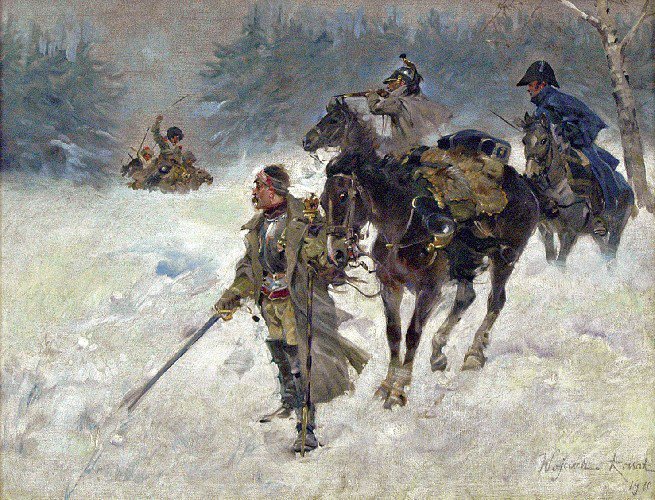


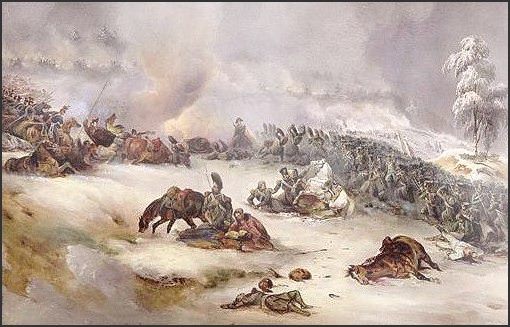




 Napoleon in Russia